


The use of vacuum systems Leybold GmbH (Oerlikon Leybold Vacuum GmbH) in drainage containers technology intended for long-term dry storage of nuclear fuel after working
For storage of spent nuclear fuel assemblies (fuel cell) it is necessary to make preliminary dehumidification inside a special container.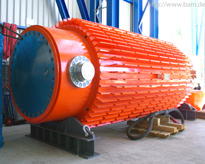
In recent years, the volume of use of nuclear energy increased significantly, which resulted in increase in the number of reactor sites in the territory of which the wet storage of nuclear fuel rods in the coming 10-year period. This phase content of the water bearing binding, then the stage is replaced by dry storage, for which special CASTOR containers are used. This name stands for «cask for storage and transport of radioactive material», which literally means “sheath for storage and transportation of radioactive materials.”
The length of such containers (with a wall thickness of 45cm) is 6 m, and the diameter – 2.5m. Particular attention is paid to a considerable sense that the elements containing the spent nuclear fuel, permanently emit energy of the order of 1 kW, while keeping the temperature at about 60 ° C.
There are various processes for dry storage of spent nuclear fuel, in this case deals with the process, wherein the degassing step is conducted 2: preliminary draining, evacuation for long term storage.
Pre-draining:
- Evacuation to extract liquid water (due to the pressure difference)
- Evacuation to 6 mbar (at a higher vacuum may form inside the ice container CASTOR)
- Evacuation time: a few hours
- Ice and condensate precipitated in the quick connection and the particulate filter
Deep vacuum (for long-term storage)
- Connecting the vacuum system directly to the container
- Evacuation to 6 mbar (at a higher vacuum may form inside the ice container CASTOR)
- Evacuation time: 2-5 days
- Total water removed: 10-60 l
- Removable water enters the test
- In some cases, the container is letting the helium to accelerate the drying process and reduce the residual moisture. In this case, the limiting container pressure 0.5 mbar
Oerlikon Leybold Vacuum GmbH offers a variety of vacuum systems, depending on the technology:
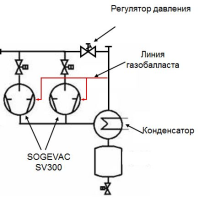 Ordinary (standard version) closed vacuum system – 2 single-stage rotary vane vacuum pump SOVEVAC SV300 on a single frame
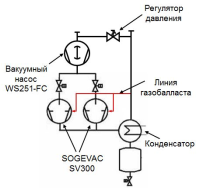 A closed vacuum system for evacuating with an overlap gels – 2 single-stage rotary vane vacuum pump SOVEVAC SV300 Roots vacuum pump in a special airtight by WS 251-FC in a single frame
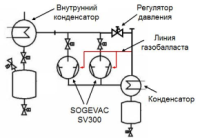 A closed vacuum system for evacuating high load on the water – is 2 single stage rotary vane vacuum pump SOVEVAC SV300, internal condenser (water cooled) at a single rameSpetsialnye predyavlyat requirements for vacuum systems:
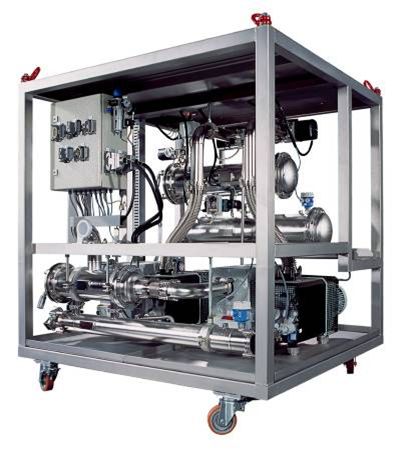
- The impossibility of using an external water cooling – vacuum supply system with a closed water circuit
- Inability to use compressed air to drive the valve – only electric
- The vacuum system is necessary with a semi-automatic control
- Only use ball valves
- durable construction
- The need for special wheels of the vacuum system to avoid damage to the flooring – countering the spread of contamination from leakage.
- All threaded connections should be are locked
- The possibility of rapid replacement of the vacuum pump and control system – all electrical contacts quick