


Vacuum drying system main pipelines.
General information about the drying of the main pipelines.
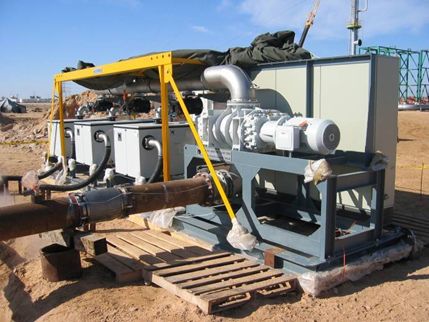 The gas is transported in the pipes under high pressure. After laying of the pipeline, it is necessary to purge and hold its molding (test pressure to test the strength and integrity). The most common way is to carry out hydraulic tests. After the test data and the overflow conduit remains moist inside.
The moisture inside the pipeline to be removed (i.e., necessary to carry out the drying process) as its presence results: contaminated gas transported, occurrence of liquid with gas reactions of corrosion. Some gases by reaction with water to form a solid precipitate (eventually occurs zarostanie pipeline).
But not only the hydraulic tests are due to corrosion within the pipeline. During transportation and storage of the pipeline elements are exposed to the atmosphere, for example during transport by sea pipes inevitable contact with corrosive hydrochloric atmosphere. Before mounting the constituent elements of the pipeline must first be cleaned of rust.
The final cleaning and testing of pipelines – the last stage, when it is possible to carry out any work in the future (after the pipeline start-up) any work lead to enormous material costs. Cleaning and drainage pipeline are crucial to the subsequent long-term trouble-free operation.
Basic methods of drying (dehumidification) main pipeline after the step of purification:
1. The hot air supply duct
The pipeline is fed hot air. The air is saturated with moisture, thereby taking it out of the pipeline. Dehumidification is carried out sectionally.
Advantages:
Air – cheap medium receiving hot air especially in hot and dry areas presents no particular difficulties
Relatively short time drying cycle
disadvantages
Passing through conduit supplied hot air cools down (the lower the ambient temperature the faster), respectively, the ability to absorb moisture (up to saturation) falls.
For complete drying requires large expenditures of hot air
Compressors are needed to supply compressed air (additional capital costs and high energy consumption)
With increased environmental humidity, air must be pre-dehumidified
The length of the drained portion of the conduit confined factors: cooling the hot air under low ambient temperature, and pressure drop along the pipe
Requires external filter effluent feed air
2. Drying air supplied to the nitrogen pipeline
This method is identical to the dewatering with hot air. The air used substituting nitrogen. In most cases, after purging with a hot air duct let in an inert gas (usually nitrogen, as the available), so this method has spread.
Advantages:
There is no possibility of explosion / fire (which either react with the transported gas) due to the nitrogen inert.
The feed hot nitrogen has a lower humidity than the hot air from the compressor therefore it has great absorption capacity
Disadvantages:
Drawbacks hot air blowing
method is more expensive due to the need for nitrogen station, greater than that required to fill the pipeline after nitrogen purge air.
3. The vacuum drying method (drying) of the main pipeline
The conduit must be completely sealed and evacuated special vacuum system. The water will be entrained with the pumped gas to evaporate when the vapor pressure – evaporation will occur all over the screen split-off conduit. You can determine the approximate time of pumping using our free service. Note that when calculating the drying process of the pipeline needs to know the amount of residual moisture in the line – to estimate the amount of liquid necessary for removal.
dignity
The method is suitable for draining large areas of the main pipeline (existing installations of 100-1500 km);
Perhaps draining complex (Configuration) pipeline sections;
Compact arrangement of the vacuum system on a single frame;
High dewatering degrees (minimal residual moisture as compared to other methods);
The implementation process of drying (dehumidification) main pipelines vacuum systems Oerlikon Leybold Vacuum GmbH
Dewatering long large-diameter pipelines (important for underwater pipelines);
Possible to drain all closed branches of the pipeline, complex areas;
No interaction with the transported gas – after drying in vacuum the pipeline;
It achieved high purity of the internal volume of the main pipelines;
Smaller dimensions of the vacuum system as compared with the method of drying with hot air;
Smaller energy consumption compared with the method of drying with hot air;
Lower cost of equipment compared to the method of drying with hot air.
The following points should be considered when choosing the vacuum system:
A large amount of water, solid particles in the pumped medium
Specific requirements of climate: dusty, dirty air environment (desert), high humidity (tropical climate), high and low temperatures during the day / year (desert / sharply continental climate), low external air pressure (high altitude)
Refrigeration units vacuum system
The temperature of the drying process, as possible duct icing at low temperatures. Ignoring requirements leads to an increase in drying time of the process, the presence of residual moisture in the main conduit
Pipes with small diameters create a significant reduction in pumping rate, i.e., the need to choose the optimal vacuum system for a particular type of main pipelines
Specific requirements for the execution of the vacuum system on a rigid frame, to meet the rigors of delivery to the place of operation
The main reason for using a vacuum drying main piping
possibility drying complicated piping configuration
method is excellent for drying long pipeline sections
achieving low residual moisture after drying
ease of connection to the pipeline system, vacuum system mobile performance
for operating the vacuum system is necessary only electricity (cooling water, inert gas, etc. – for a reliable operation is not needed)